


8 min read
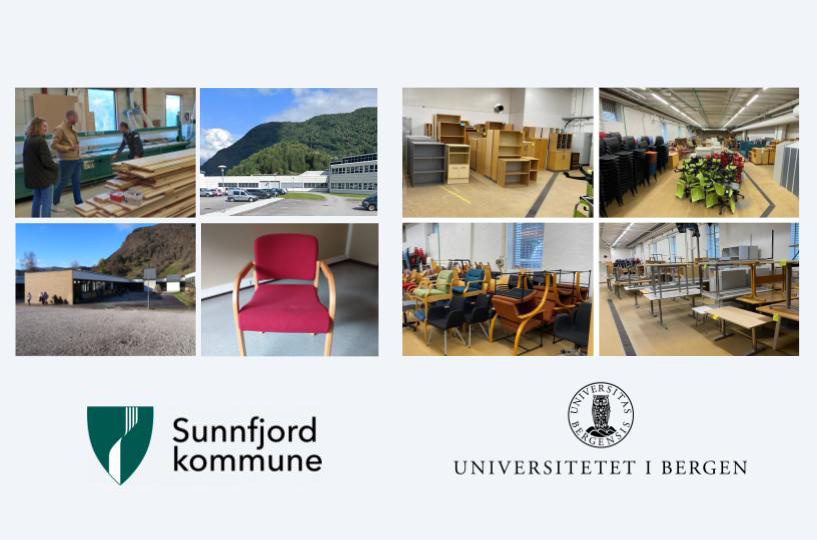
Every year, large amounts of fully usable furniture and building materials are thrown away in the education sector during renovation, rehabilitation, change in student numbers, closure or merging of schools. This happens despite the fact that schools are facing tighter budgets and municipalities and county authorities have increased requirements for sustainability. What does it take to create good logistics solutions that make circular economy a natural part of everyday life in schools and the education sector?
Read excerpts from the interview with Truls Hansen Folkestad (Climate and Environmental Advisor - Sunnfjord Municipality) and Anette Mjørlaug Spord (Group Leader Interior and Signage - University of Bergen /UiB) from our webinar "Circular Schools and Reuse in Educational Buildings". Truls and Anette share their insights and concrete practical solutions for how to facilitate systematic reuse in the education sector.
.jpg?width=715&height=402&name=Webinar%20mars%202025%20(7).jpg)
What was the background for focusing on circular economy and reuse?
Truls (Sunnfjord municipality): Climate change plan 2019, circular economy and reuse priority area. Initiative from Vill Energi and Circular Norway 2021, pilot project on the potential in the municipality. R&D project at NORCE in 2021-2022. Decision in the municipal council on reuse in a specific construction project.
Anette (UiB): In 2018, the University Board adopted a number of measures to reduce UiB's greenhouse gas emissions. One of the sub-goals was that UiB would work systematically to reduce emissions from the purchase of goods and services. Among other things, a working group was set up to come up with proposals for short-term and long-term measures for the use and purchase of furniture at UIB. An overall goal here was to increase reuse and reduce the purchase of furniture. We have been working on this since then, and have taken step by step further in the right direction.
How do you work with reuse today?
Truls (Sunnfjord municipality): The municipality began reusing materials in 2022 in connection with the renovation of Sande School. We have used Loopfront since then to survey and communicate to employees. We also have an internal channel on Teams for reusing materials, which concerns inventory. Reusing materials has also become a more important criterion in our purchasing work.
Building materials and equipment are being worked on in a new project to establish a recycling center where we will use both Sirken and Loopfront. The pilot for the recycling center will pave the way for a permanent solution where others than the municipality operate the service, e.g. a recycling company.
.jpg?width=960&height=540&name=Webinar%20mars%202025%20(11).jpg)
Anette (UiB): We mainly reuse furniture, but also some building materials such as LED light fixtures, card readers, doors, windows, etc. We have a large storage with reused furniture (500 m²). The furniture we have here comes partly from UiB areas that, for various reasons, need to be cleared out, or from employees who have too much furniture. All the furniture in the storage is registered in Loopfront. We started this work in autumn 2022. It took some time, and therefore at first we only had a limited number of employees in Loopfront for a while, but in January 2025 we opened up so that all UiB employees who wish can get access to the Marketplace.
Due to limited capacity, the reuse storage is staffed only about half a day a week. (At that time we pick out the furniture that has been ordered through Loopfront and get it ready for collection by UiB’s internal transport section.) We are a team of three people who manage the furniture we have in the storage.
.jpg?width=960&height=540&name=Webinar%20mars%202025%20(10).jpg)
In the Property Department, we have two interior architects who actively work on using reused furniture in their interior projects. The furniture is either used as it is, or redesigned in various ways. Among other things, we redesign large sit/stand corner desks, where we replace the tabletops and remove one of the legs; we also buy new parts (seats, backs, armrests, headrests, wheels) for office chairs. It costs a bit, but as long as the chair mechanisms still work, we save the environment from a lot of emissions.
In autumn 2022, we hired a reuse coordinator who, among other things, has main responsibility for the reused furniture and for Loopfront.
What results have you achived so far with reuse?
Truls (Sunnfjord municipality): So far, we have surveyed 5 buildings, with the potential for more. Around 5,000 items of inventory. 41 different items have been given away over the course of 3 months, with a value of NOK 224,000, 1.5 tonnes of CO₂e, and 1,000 kg of waste saved. Many employees are positive.
We have also identified the potential for reuse of materials in the Sande School project, but for now it is uncertain what the final result will be.
.jpg?width=960&height=540&name=Webinar%20mars%202025%20(8).jpg)
Anette (UiB): We have focused on surveying the furniture we have in the reuse storage rather than mapping the furniture we have in all of our nearly 100 buildings. The exception was when we completely rehabilitated our administration building in the period 2021–2023. Then a requirement came from the UiB management that we had to achieve as much reuse of furniture in this building as possible.
We managed to do a lot, and it actually turned out very well. It is a building of about 17,000 m², 9 floors, 400 workspaces, meeting room areas, a café. We achieved around 40% reused furniture of the total number of furniture items in the building, and have saved about NOK 7 million and around 125 tons of CO₂ equivalents in this project..jpg?width=960&height=540&name=Webinar%20mars%202025%20(9).jpg)
The number of furniture items going out per month increased by 20% from 2023 to 2024, and by 75% from 2024 to 2025. In collaboration with the Procurement Section, we have changed UiB’s procurement routines so that you must first be sure that you actually need the piece of furniture, then check whether the furniture you already have can be repaired, or whether someone nearby has one to spare. After that, you check in Loopfront, or post a request in a furniture-swap team we have in Teams. Finally, you contact a supplier to ask whether they have used furniture for sale, and only as a last step buy new furniture.
"By adopting Loopfront, we have opened up a new world for employees who need furniture. It is now much easier for them to find used furniture, and because we also arrange transport, the threshold for ordering furniture in Loopfront is low. We generally notice a changed culture around the reuse of furniture."
- Anette Mjørlaug Spord (Group Leader Interior and Signage - University of Bergen)
Related Posts
Regulations are the same for both new and used building products
In April we interviewed Matias Apelseth from Kluge Law Firm on legal issues related to re-use of ...
Tips: Create value from your reuse survey
Both Swedish and Norwegian legislation require that buildings facing demolition or major rebuilding ...
SWECO conducts sircular surveying for Bergen Municipality
Reuse surveying is an effective way to get an overview of what resources you have available, so ...